
01
The daytime shots are flawless, the night shots pitch black.
Alkaline, single-use lithium, NiMH or lithium-ion: which cell belongs in your trail camera – and why capacity is the wrong number to go by.
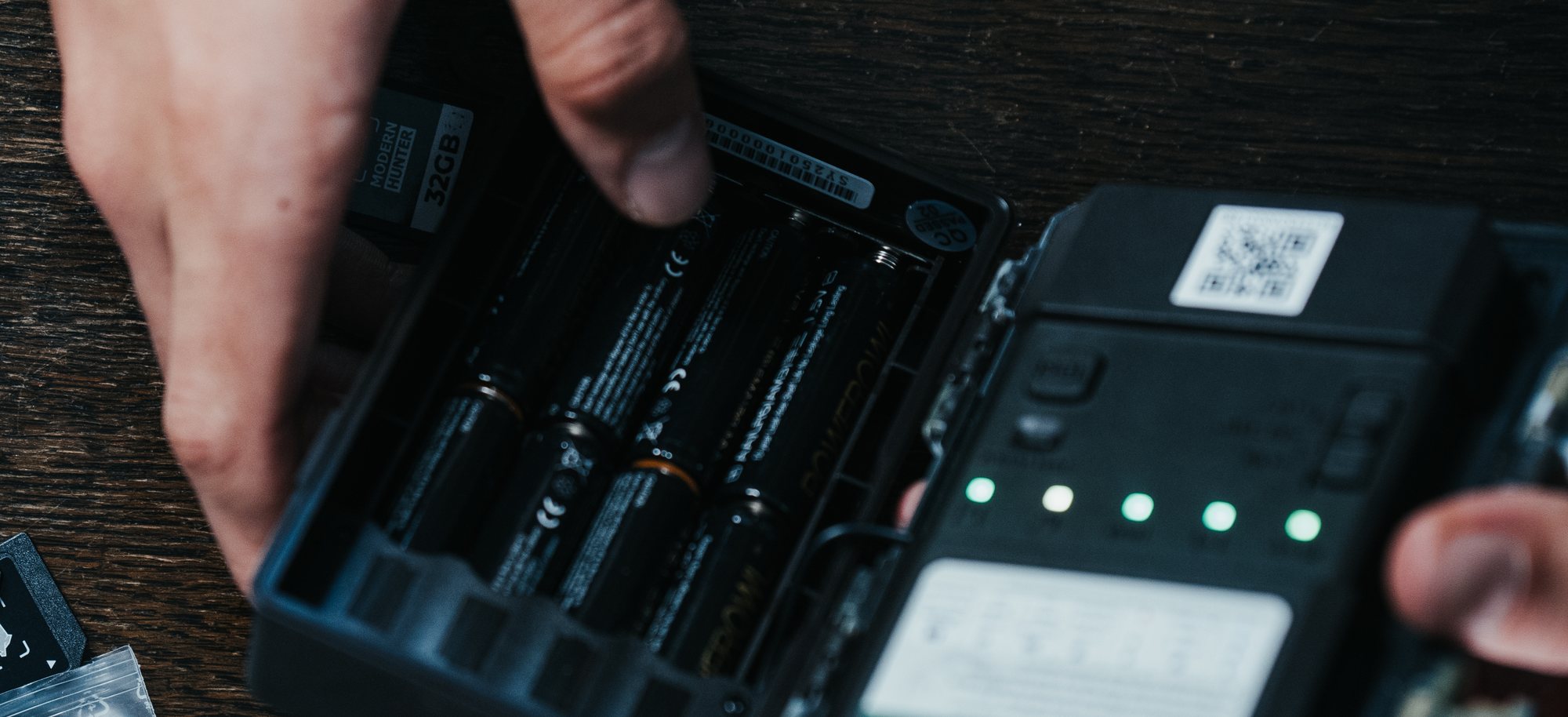
For trail cameras in AA format there are exactly four types of cell. Two are single-use, two can be recharged. Each one has a characteristic discharge curve – and that curve is precisely what decides what your camera gets out of it.
Cheap and available everywhere. Solid in summer and in photo mode – weak in frost and on night video.
The strongest cell, unbeatable in the cold – at many times the price.
Cheap and cold-proof – but only delivers 1.2 V. Not every camera can cope with that.
A constant 1.5 V, usable all year round – and it warns you before it runs out.
Almost everyone looks at the capacity in milliampere-hours when buying batteries. It matters – but it's only half the truth, and for trail cameras it's the less interesting half.
That's because a trail camera doesn't draw power evenly. Most of the time it dozes in standby mode and pulls almost nothing. When the motion sensor triggers, demand shoots up within milliseconds: activate the sensor, capture the image, write it to the card – and at night fire the infrared LEDs on top of that. On cellular cameras, the mobile module joins in and transmits the capture afterwards.
The real question isn't “how much energy is in there”, but rather: does the cell hold its voltage when a lot of current is demanded all at once?
On paper, a cell can still be well filled and yet be too weak for the moment of triggering. If the voltage then collapses, these are the consequences:
They have two load peaks instead of one: first the flash, then the transmission. With poor reception it gets worse – the camera needs longer to register on the network and transfer the file, and draws current for correspondingly longer. A camera at a location with thin network coverage is therefore doubly dependent on cells that can take a load.
Almost every trail camera user knows these four patterns. None of them is a defect – each one can be traced back to a cell type and its discharge curve. They'll come up again and again in this guide.
The daytime shots are flawless, the night shots pitch black.
The indicator sits at 99 % for weeks – and on the next check the camera is dead.
The camera runs perfectly for weeks, then quits for no apparent reason – and later starts working again all by itself.
You measured every single cell, all the readings were good – and the camera was flat anyway.
Practically every trail camera runs on AA cells. Alongside that, almost every manufacturer offers its own lithium battery pack that only fits its own cameras. These packs work well, and there's nothing to be said against them – but there are two points you should have thought about beforehand.
If you run out of power out in your hunting grounds, you can get AA cells at any petrol station, in any DIY store, in any supermarket – if need be on holiday at the other end of Europe. If the manufacturer's pack is empty, on the other hand, your day is over. Replacements are only available from specialist dealers, and usually not straight away.
A trail camera in the 150 to 250 euro range is not an heirloom. Technology and designs change every year, and at some point the camera is done for or gets replaced. The battery pack then no longer fits into anything and is worthless. A good set of AA rechargeables, by contrast, easily outlives the camera and moves on to the successor model, to the second camera, or at worst into the torch.
That's exactly why at Modernhunter we don't use special battery packs that only fit our own cameras. As a matter of principle, we build our products so that standard off-the-shelf batteries and rechargeables fit into them – so that you can get a replacement in your hunting grounds at any time, and your set of cells is still good long after the camera has been replaced.
Alkaline cells are the obvious choice: cheap, available everywhere and supported by every camera. For short deployments at mild temperatures they're perfectly adequate, too. In trail cameras, though, you keep running into their limits – and their voltage curve shows exactly why.
Battery manufacturers determine the printed capacity by running the cell all the way down to 0.8 V. Everything that comes out up to that point goes on the pack. Camera manufacturers know, however, that an alkaline cell stops delivering enough power for the infrared flash well above that limit. So that the camera doesn't produce black night shots, they shut the device down completely before that point – depending on the model at around 1.0 V.
The entire range between 1.0 V and 0.8 V is therefore included in the capacity figure, but it's unreachable for your camera. Of the stated 2,000 mAh, you never get all of it. You're paying for capacity that your camera is designed never to touch.
This is where symptom 01 and symptom 04 both resolve themselves at the same time.
Alkaline cells cope badly with sudden load peaks. At rest – with the camera just waiting – a used cell dutifully shows its 1.5 V. Everything looks healthy. Then game walks past, the infrared flash fires and abruptly demands many times the power. The cell can't deliver, the voltage collapses below the threshold the flash needs: black image.
As soon as the flash is off, the cell recovers and climbs back to a value that's perfectly sufficient for a daytime photo. That's exactly why the camera seems in perfect health during the day and fails only at night. No-Glow cameras are hit particularly hard, because their invisible 940 nm flash draws considerably more energy than a Low-Glow model – and so are video recordings, where the flash doesn't fire briefly but keeps going for 10 to 15 seconds at a stretch.
A meter without a load measures the resting voltage. On an almost exhausted cell, that can still be 1.45 or 1.5 V. Apply a load at that very same moment and the same cell collapses immediately.
An alkaline cell can show you a voltage that it can't hold under load. Anyone who measures without a load is measuring the wrong thing – which is why the cells from symptom 04 were “fine” and the camera was dead all the same.
The chemistry of an alkaline cell is water-based, and cold cripples it. If the temperature falls from 15 to 20 °C down to −5 to 0 °C, voltage and usable capacity collapse drastically – below freezing point around half the capacity is lost, and sometimes the cell quits entirely.
The decisive point: this is reversible. When it gets warmer again, power and capacity come back. That is exactly symptom 03 – the camera quits during the coldest spell, stands in your hunting grounds for weeks apparently defective, and resumes operation in spring as if nothing had happened. The cells were never empty. They were too cold.
For Europe that's not a fringe issue but the normal case: the driven hunt and high-seat season from October to January regularly falls within the freezing range in Central Europe, and all the more so in Scandinavia.
The classic: after the season, the cameras go into a box with the cells still inside. The next summer you open the battery compartment – and find a white, crystalline, corroded mess. Leaking alkaline cells destroy the contacts and take the camera with them. A battery problem turns into a total write-off.
Cheap, available everywhere and the only cell that can be measured reliably. In the warmer months and in photo mode – where the flash only fires briefly and comes nowhere near the peak load of a night video – you can use them without hesitation. Their limits lie elsewhere: in frost, on long night videos and during long deployments without a check. In those cases, go for branded cells rather than no-name – and never leave the cells in the device over the storage period.
Single-use lithium cells are the opposite of alkaline: technically superior, and in several respects without competition. Even so, many people don't use them, and the reasons are solid.
Because the voltage stays unchanged for weeks, the camera has no way of determining the remaining capacity. It reads the flat curve and reports 99 %. The next week 99 % again. And again. Then the cell reaches the end of its curve, collapses abruptly – and on the next check the camera stands dead in your hunting grounds.
The indicator wasn't lying, it simply couldn't have known any better. There is no reliable way of checking the remaining capacity with single-use lithium.
The price. A single-use lithium cell costs many times as much as an alkaline. It lasts about twice as long – so on paper there's still a clear deficit. For a single camera at a critical location that may be justifiable. But with a double-digit number of cameras in continuous operation it simply gets seriously expensive.
One round and gone. Like alkaline, they're waste after a single run – just at many times the price.
Shipping by air freight. Loose lithium metal batteries are subject to strict restrictions as air freight and are not permitted on passenger aircraft. If you send cameras together with cells abroad, you'll hit a real limit here. This doesn't apply in the same way to your own air travel: cells with up to 2 g of lithium content are permitted in hand luggage, and an AA lithium cell is clearly below that at around 1 g.
The smell. A point that has only come to light in recent years and is particularly unpleasant for trail cameras: single-use lithium cells give off a gas that is clearly perceptible even to humans. Field research reports that canids – wolf, fox, raccoon dog – can smell the cells and reliably locate the camera site as a result.
Technically the strongest cell, unbeatable for cold, weight and runtime. Its place is where reliability is everything and price counts for nothing – winter operation, far-flung locations, long deployments. For continuous operation across many cameras it's too expensive.
Type 01 and type 02 have one thing in common – after a single run they're waste. So let's turn to the two types that can be recharged hundreds to over a thousand times.
If you tried rechargeables years ago and gave up in frustration, read on anyway. The bad reputation is deserved – but it comes from a different era. The early cell chemistries barely lasted, developed the notorious memory effect and were expensive on top of that. Anyone who switched back then usually came to the conclusion that rechargeables are no good for trail cameras.
That has changed completely. Today both types of rechargeable are widespread in the trail camera world and genuinely fit for practical use.
There is no such thing as the perfect cell. With all four types, one or two drawbacks remain. It's not about finding the test winner, but about finding the drawback that hurts least in your hunting grounds.
NiMH rechargeables are attractively priced and unimpressed by the cold. For the European hunting season from October to January that's precisely the decisive point – the winter that alkaline fails in doesn't bother NiMH at all.
Before you buy, however, you have to settle one question. And it decides whether NiMH will run sensibly in your camera at all.
NiMH only deliver 1.2 V, but trail cameras are designed for 1.5 V per cell. With four cells the camera expects 6 V and only gets 4.8 V; with eight cells, 9.6 instead of 12 V. So a fully charged NiMH set looks to the camera like a half-empty set of alkalines.
Many cameras can't cope with that. Typical consequences: the camera shuts down even though the rechargeables are full, permanently reports a low battery level, or the infrared flash no longer reaches its full power at night.
So before you buy, always check whether your camera explicitly supports 1.2 V rechargeables. Many models offer a battery type setting in the menu for this – if it's missing, be careful. Everything else depends on this one question: if the voltage doesn't fit, then neither the price nor the cold resistance is any use to you.
Above roughly 27 to 29 °C the capacity drops significantly. That's not an exotic limit: a European midsummer day is already enough, and inside a closed camera housing in blazing sun the temperature is noticeably above the ambient air. If you run a sun-exposed camera through July and August, you should factor that in. That makes NiMH more of a winter rechargeable than an all-year one.
Unlike single-use lithium, NiMH are allowed to travel with you without special rules. If you take cameras along on a hunting trip abroad, you've got a clear run here.
NiMH begin to discharge as soon as they come off the charger. You can't charge them fully, put them in a drawer for two months and then fit them fresh – the set goes into your hunting grounds already weakened. So only charge them when you're actually heading out.
If you can't reliably manage that, go for NiMH with low self-discharge – often sold in the shops as LSD cells. They hold their charge considerably better during storage and noticeably defuse this drawback.
There's hardly another type of cell where claim and reality diverge so far. Very cheap NiMH rechargeables often have so little usable capacity that their runtime even falls short of good alkaline batteries – and then you pay for the rechargeability with constant check-up trips.
Cheap, cold-proof, cleared for flying and paid off after two to three charges – provided your camera can cope with 1.2 V. That question comes before all others: if the answer is no, NiMH is out, no matter how well the rest fits. After that, two weaknesses remain: heat and self-discharge.
This point is almost always overlooked – and it ruins more rechargeables than any deployment out in the field.
The early NiMH rechargeables were charged with timer chargers: cell in, eight hours of current, done. The problem is obvious as soon as you say it out loud: every cell comes back from the field with a different residual charge. Stubbornly charging a half-full cell for eight hours means overcharging it – and that destroys the battery. A good part of the bad reputation of rechargeables comes from exactly that: it wasn't the cells that were bad, it was the chargers.
What you need instead is an intelligent charger. You can recognise one by two things:
As a rule, a NiMH charger is not suitable for 1.5-volt lithium-ion rechargeables. The two cell types look the same from the outside but work completely differently on the inside – the Li-Ion cell has its own charging electronics, which a NiMH charger can't address.
For Li-Ion cells, use only a charger approved by the manufacturer. That's not a warranty question, it's a safety question.
If there is such a thing as a universal solution, then it's rechargeable lithium-ion cells in AA format.
They pay for themselves quickly. They're expensive to buy. After the second charge, or the third at the latest, they've paid for themselves – from then on you charge for free.
Temperature is a non-issue. Neither heat nor cold impresses them. Whether in blazing midsummer sun or in Scandinavian frost: unlike with alkaline or NiMH, you don't have to choose between the seasons.
No smell. Lithium-ion rechargeables don't have the outgassing behaviour of their single-use relatives. So game – and canids in particular – can't pick out the camera via the cells.
The native voltage of a lithium-ion cell is 3.7 V – but trail cameras expect 1.5 V per cell. How does that fit together?
In the cap of the cell sits a microprocessor that regulates the output voltage. No matter what the native voltage does inside and how far it sinks over the cell's lifespan: exactly 1.5 V comes out at the contact. Immovably.
That makes it the most constant power source you can get. A current draw of 1 A, an invisible No-Glow flash, even video – the cell carries it. Internally the voltage may briefly dip during such a load peak and come back up again; at the output it stays 1.5 V. Precisely the collapse under load that causes the black night shots with alkaline is ruled out here by design.
For a long time, the constant voltage came at the same price as with single-use lithium: symptom 02. If the cell shows 1.5 V after a month and still 1.5 V after three months, then every measurement is worthless. A reliable check of the remaining capacity was simply impossible.
This is exactly where the cell generation of recent years has taken a decisive step forward. Modern Li-Ion rechargeables deliberately let the output voltage sink slowly and predictably from around 80 % of their lifespan onwards instead of holding it until it crashes. Depending on the camera and trigger frequency, that gives you a window of several months in which you can see: this set needs replacing soon.
Pay close attention to this when buying. Not every Li-Ion cell offers it. If you have the choice, take the version with readable remaining capacity – that's the difference between a planned swap and a dead camera at the decisive moment.
As an example, the key data of the XTAR CLR 4300, a cell developed for trail cameras:
| Capacity | 2,700 mAh / 4,300 mWh |
|---|---|
| Output voltage | constant 1.5 V |
| Charge cycles | over 1,200 |
| Operating temperature | −20 °C to +60 °C |
| Charging time | around 2.6 hours |
| Discharge curve | “Smart Discharge Curve” with early warning |
| Housing | leak- and corrosion-protected |
More expensive at first, paid off after two to three charges. Independent of temperature, absolutely constant under load, over 1,200 cycles – and with the remaining capacity display the last real drawback falls away. For most users this is the right choice.
Do you remember type 01? The alkaline cell has exactly one real strength: its evenly falling curve, from which a tester can reliably read how much is still in there.
And that is precisely the property that the manufacturers of modern Li-Ion cells now deliberately recreate. The technical term for it is “Smart Discharge Curve”: towards the end of life, the electronics mimic the curve of an alkaline cell – not because that would be technically necessary, but so that your camera's battery indicator once again shows something you can rely on.
The best rechargeable on the market combines the strength of Li-Ion technology with the one strength of the alkaline – and leaves out every one of its weaknesses.
| 01 · Alkaline | 02 · Single-use lithium | 03 · NiMH | 04 · Lithium-ion | |
|---|---|---|---|---|
| Purchase price | low | high | medium | high |
| Cost in the long run | new for every deployment | new for every deployment | paid off after 2–3 charges | paid off after 2–3 charges |
| Voltage | 1.5 V falling | 1.6 V flat | only 1.2 V | 1.5 V regulated |
| Camera compatibility | always | always | only with 1.2 V approval | always |
| Cold | poor · 33 % | very good · 97 % | good · 83 % | good · 78 % |
| Heat | usable | very good | poor from 27 °C | very good |
| Load peak / IR flash | collapses | carries everything | good | carries everything |
| Remaining capacity readable | yes | no | yes, under load | only with display function |
| Reusable | no | no | yes | yes |
| Air freight | permitted | prohibited | permitted | restricted |
| Smell for game | no | yes | no | no |
| Battery | 22 °C | −15 °C | Remaining in the cold |
|---|---|---|---|
| AA Ultimate Lithium (single-use) | 3.430 mAh | 3.332 mAh | 97 % |
| NiMH AA (rechargeable) | 2.663 mAh | 2.197 mAh | 83 % |
| Lithium-ion AA (rechargeable) | 2.622 mAh | 2.046 mAh | 78 % |
| AA Alkaline (single-use) | 2.181 mAh | 728 mAh | 33 % |
| Symptom | Cause | Affects |
|---|---|---|
| 01 · Night shots black | Collapses under the load of the IR flash and recovers again afterwards | Alkaline |
| 02 · 99 %, then dead | Flat discharge curve – the camera can't determine the remaining capacity | Single-use lithium, older Li-Ion |
| 03 · Dropouts in winter | Loses a massive amount of capacity in frost – reversible as soon as it gets warmer | Alkaline |
| 04 · Measured, flat anyway | Measured without a load. The resting voltage says nothing about the ability to take a load | All types |
As important as the right battery type is – it doesn't decide the runtime on its own. Two identical sets of cells last for different lengths of time in two cameras, and drastically so. These factors play their part:
An economical camera can be considerably cheaper over the years than a cheaper model with high consumption. The follow-up costs are part of the purchase price – batteries, data transmission and above all your time for check-up trips. If you buy a camera 30 euros cheaper and drive out to your hunting grounds three times as often, you've done your sums badly.
There is no such thing as the perfect cell – but for every situation there's a clearly better one.
Ideally with a remaining capacity display. Usable all year round, constant under load, paid off after two to three charges.
When a failure means a long trip and the price is irrelevant, this is the strongest cell. Can't be shipped by air freight.
Only if your camera explicitly supports 1.2 V – that's the precondition. Then fit them freshly charged, and not at sun-exposed locations in midsummer.
Perfectly usable in the warmer months and in photo mode. In frost, on night videos and during long deployments they reach their limits. Prefer branded cells.
The capacity measurements come from a cold test by an independent test laboratory (245 mA load, 22 °C and −15 °C). The key data on the XTAR CLR 4300 are manufacturer specifications and were not independently re-measured.
Information on air travel according to the applicable IATA limits for lithium metal cells – in case of doubt, the information given by the respective airline always applies. The discharge curves are schematic representations to illustrate the principle, not to-scale measurement traces.